Argentine ants (Linepithema humile) thrive along coastal Southern California due to mild winters and extensive residential drip irrigation. In areas like Pacific Beach, La Jolla, and Point Loma, marine moisture enables…
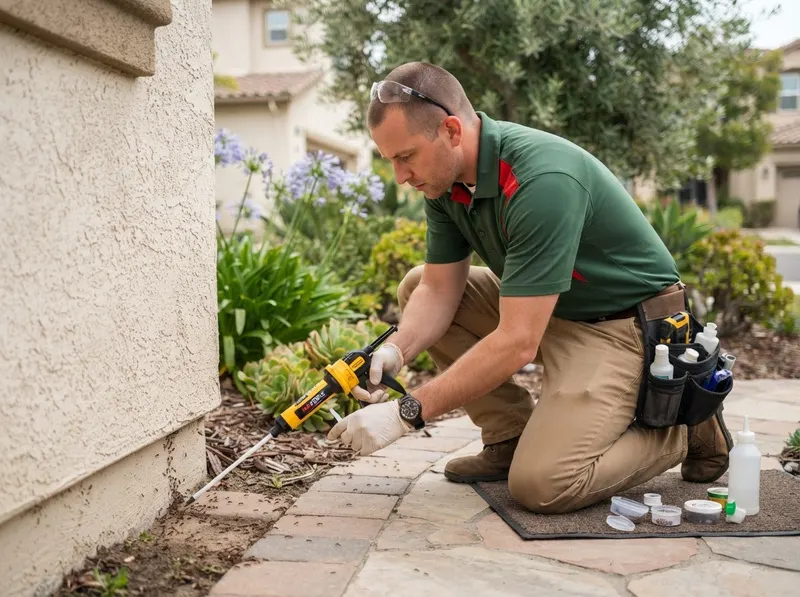
Argentine ants (Linepithema humile) thrive along coastal Southern California due to mild winters and extensive residential drip irrigation. In areas like Pacific Beach, La Jolla, and Point Loma, marine moisture enables these ants to form sprawling supercolonies that share workers across hundreds of feet of subterranean territory. When inland heat rises in Carmel Valley and Scripps Ranch, or when seasonal rains flood urban canyons near Balboa Park and Hillcrest, these ants migrate inside wall voids, pantry cabinets, and plumbing pipe penetrations. Typical retail pyrethroid aerosol sprays cause colony budding, a defensive biological reaction where a single colony splits into multiple active satellite nests, multiplying the infestation overnight. Targeted suppression uses slow-acting, non-repellent formulations that foraging workers transport back to reproductive queens, dismantling the nesting structure from within.
Selecting professional colony suppression balances long-term nest elimination against immediate structural defense. Homeowners dealing with superficial, temporary scouts near an exterior hose bib often need only physical exclusion and landscape adjustments, whereas structures facing persistent kitchen counter invasions require an active biochemical payload. The trade-off centers on patience versus disruption: fast-acting repellant sprays provide the visual illusion of an instant kill within 15 minutes, yet leave the subterranean queen network fully functional to send thousands more workers weeks later. Low-toxicity, non-repellent Integrated Pest Management protocols take between 7 and 14 days to circulate throughout the multi-queen network, but they provide durable colony decline without saturating children's play areas or living quarters with harsh chemical residues.
Properties situated along the canyon rims of Mission Hills, North Park, and Clairemont face continuous perimeter pressure from wild riparian vegetation. Ground crews begin by establishing a 3-foot vertical and 10-foot horizontal barrier zone along the structure foundation, focusing specifically on expansion joints, weep holes, and sub-slab conduits. Outdoor irrigation valves and mulch beds receive slow-release granular bait matrices calibrated to Argentine ant nutritional demands. Inside the living envelope, technicians avoid airborne sprays, applying low-impact gel baits strictly into concealed structural voids and behind electrical wall plates. This targeted suppression sequence systematically cuts off worker supply routes while keeping occupants safely inside the residence.
Every job gets a firm, written price after a free on-site visit.
Tell us about your argentine ant colony suppression job in San Diego and we'll send a clear, written quote, usually the same day.
 ClearNest Pest Control