Subterranean termite soil barrier defense protects San Diego structures from the destructive feeding habits of subterranean colonies. Unlike drywood termites that live entirely inside exposed lumber, subterranean…
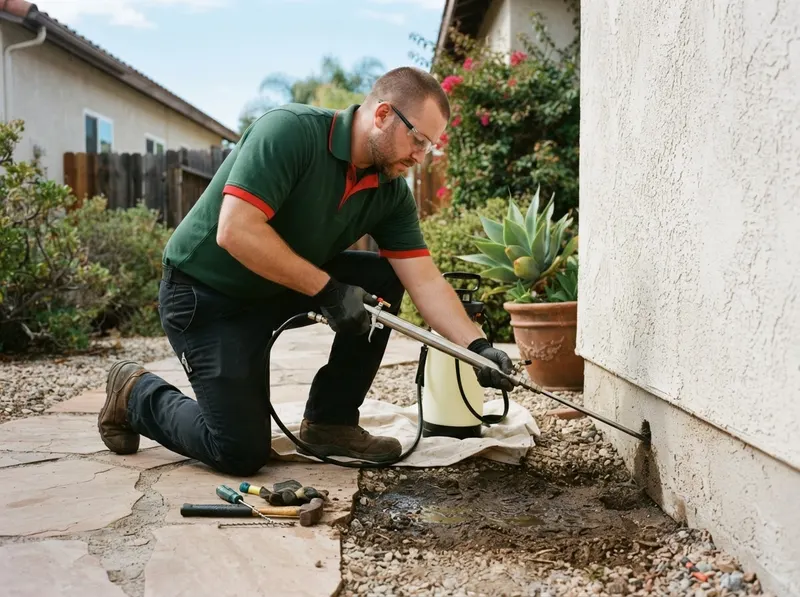
Subterranean termite soil barrier defense protects San Diego structures from the destructive feeding habits of subterranean colonies. Unlike drywood termites that live entirely inside exposed lumber, subterranean termites nest inside moist ground soil and construct mud shelter tubes over concrete stem walls to consume internal subflooring, drywall paper, and wall studs. Soil defense establishes an uninterrupted subterranean zone around the foundation footprint. A specialized non-repellent liquid termiticide bonds with soil particles without alerting foraging insects. Worker termites move unknowingly through the treated layer, pick up microscopic active agents on their cuticles, and transfer the material to the reproductive queen and nestmates through grooming and food sharing (trophallaxis), collapsing the underground nest.
Subterranean termite barrier defense fits active subterranean incursions and ground-contact breaches, offering an alternative to full-structure tent fumigation. Whole-house structural fumigation (Vikane gas) arrests drywood termites living in rafters, but it dissipates entirely within 48 hours and deposits zero residual product into the earth; it provides zero defense against underground colonies. Conversely, a continuous soil barrier remains bound within local earth substrates for 5 to 10 years, securing perimeter soil without requiring residents, children, or indoor pets to pack food or vacate overnight. For properties with expansive attached flatwork, technicians drill 0.5-inch holes spaced every 10 to 12 inches through hard concrete slabs, inject the liquid deep into sub-slab soil, and seal each port with matching hydraulic mortar.
Soil composition across San Diego County influences perimeter design. Properties in coastal enclaves like Ocean Beach, Point Loma, and Pacific Beach sit on loose, permeable sandy loam that absorbs liquid applications quickly, whereas inland clay expanses throughout Scripps Ranch, Clairemont, and Carmel Valley require slower, pressurized continuous rod injection to prevent runoff and ensure uniform saturation down to foundation footers. Shaded foundations bordering dense botanical mulch in historic Mission Hills, North Park, and Hillcrest retain moisture that accelerates termite mud-tube construction, while coastal fog layers in La Jolla create sustained perimeter humidity. Non-repellent barrier products bind tightly with soil minerals once dry, eliminating vapor hazards and preventing chemical leaching into residential gardens.
Every job gets a firm, written price after a free on-site visit.
Tell us about your subterranean termite soil barrier defense job in San Diego and we'll send a clear, written quote, usually the same day.
 ClearNest Pest Control